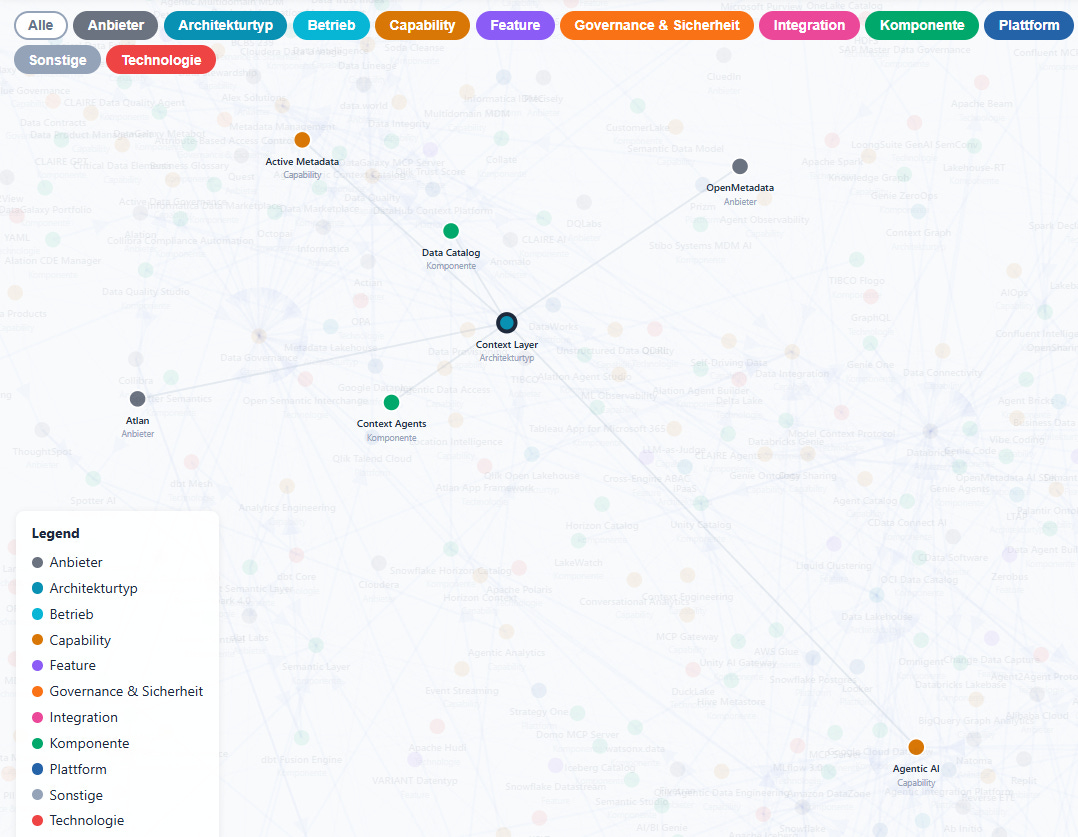
Context Layer and Context Engineering
How Data Intelligence Platforms Enable Trusted AI

From Metadata Repository to Runtime Infrastructure
Data intelligence platforms have spent a decade solving a human problem: how do analysts find, understand, and trust data in a large organization? The answer was the data catalog - a searchable, governed inventory of assets, definitions, and lineage. It worked. And it is no longer sufficient.
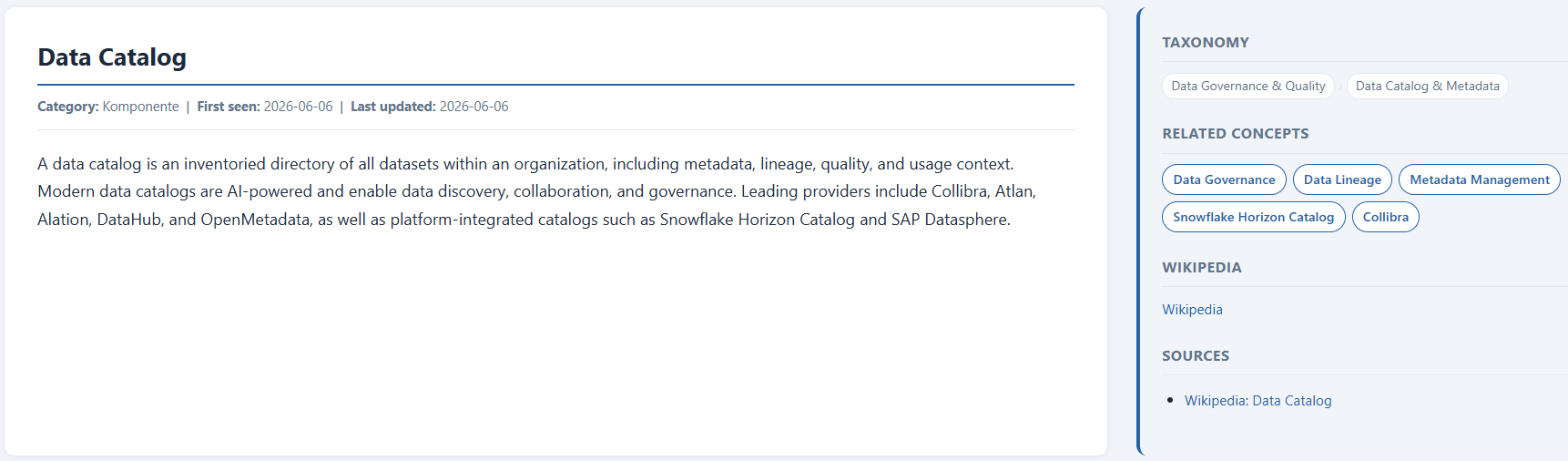
A structural shift is underway in the market. Three trends are converging:
AI is automating metadata management tasks that previously required human curation
AI and ML assets are becoming first-class catalog objects alongside tables, dashboards, and pipelines
Platforms are taking on a new role as context providers - feeding metadata to AI agents at inference time to make them more capable and more trustworthy
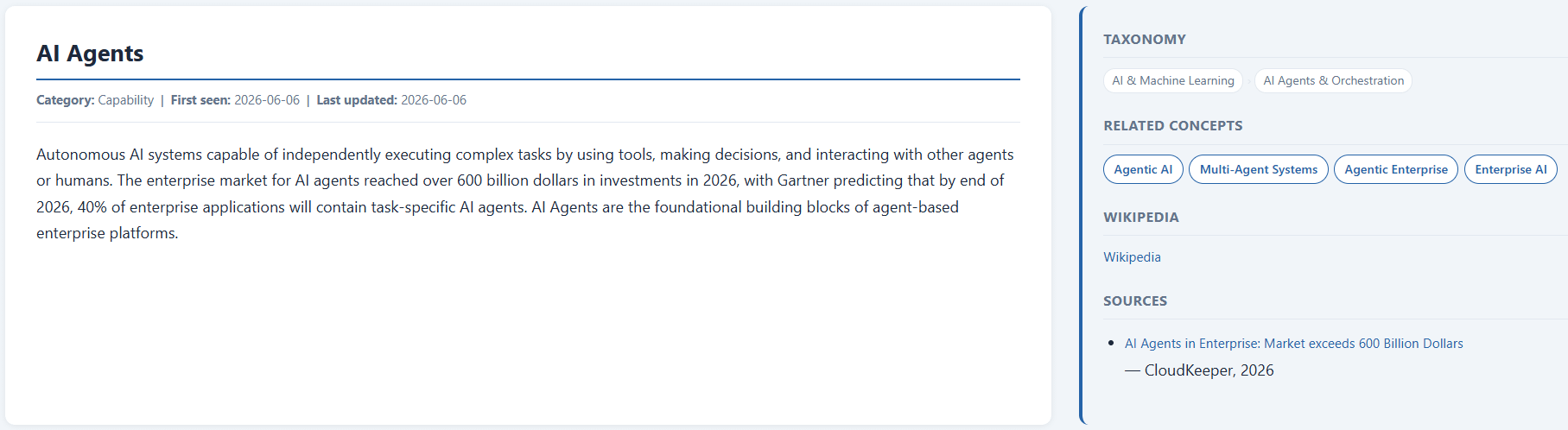
That third trend is the most architecturally significant. It changes what a data intelligence platform fundamentally is - and introduces a new discipline that organizations must build alongside the platform itself.
Three Concepts, One Stack
Semantic Layer
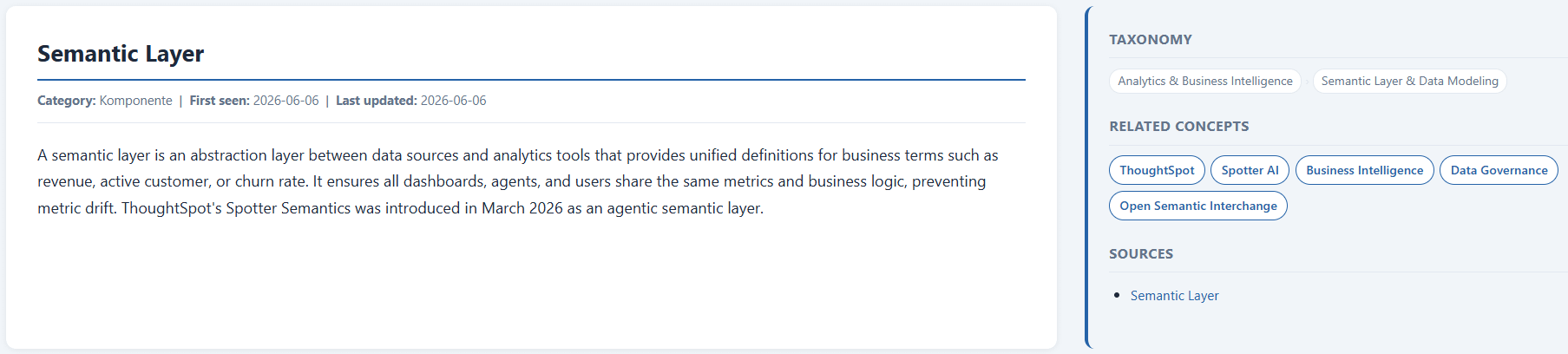
A persistent, governed representation of meaning. It links technical assets (tables, columns, lineage, documents, technical policies) to business concepts (glossary terms, business entities, relationships, governance and data quality metrics) so that humans and machines can interpret data consistently. This is what data catalogs have always built. The semantic layer is infrastructure: it exists before any question is asked.
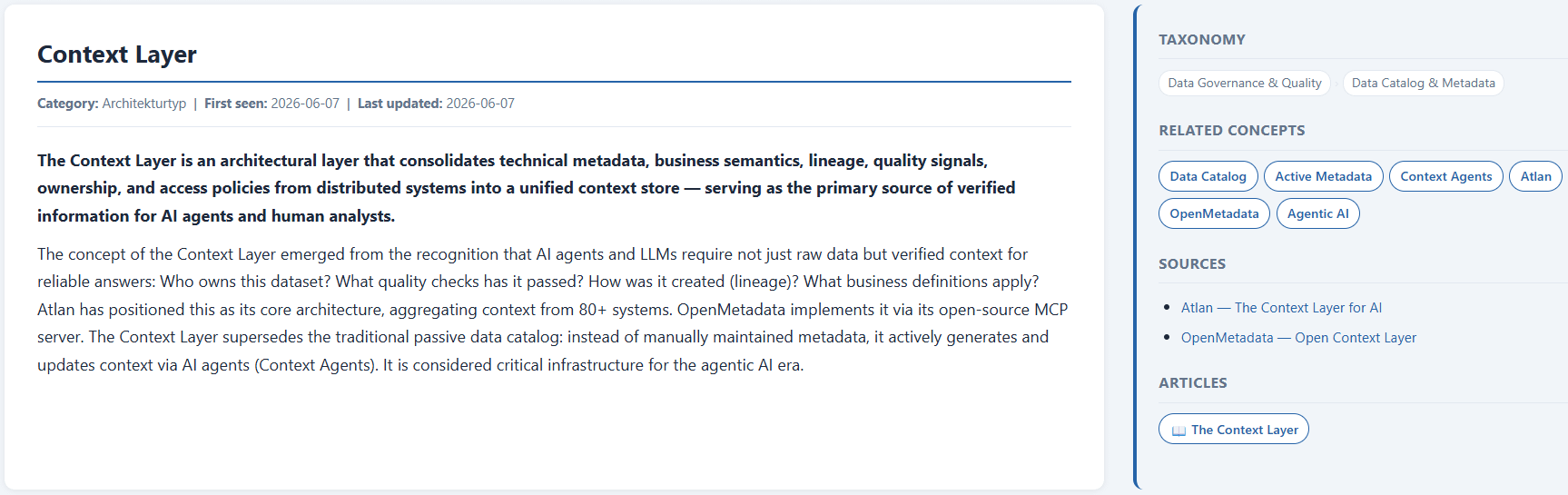
Context Layer
A runtime service. Rather than a static repository, the context layer assembles a request-time, task-specific package of information and control signals. It selects the right context for a given prompt — facts from a relational database, a policy constraint, a lineage path, a quality score — while enforcing trust, permissions, and guardrails, and enabling reproducibility, state management, and efficiency.
The relationship between semantic and context layer is precise: semantics defines meaning; the context layer supplies the right, permissible meaning and evidence for the specific question or action at hand.
An AI agent querying enterprise data does not need the entire catalog. It needs the subset of governed, fresh, permissioned context relevant to its current task — assembled quickly, traceable, and bounded by whatever access controls apply to the requesting agent identity.
Context Engineering
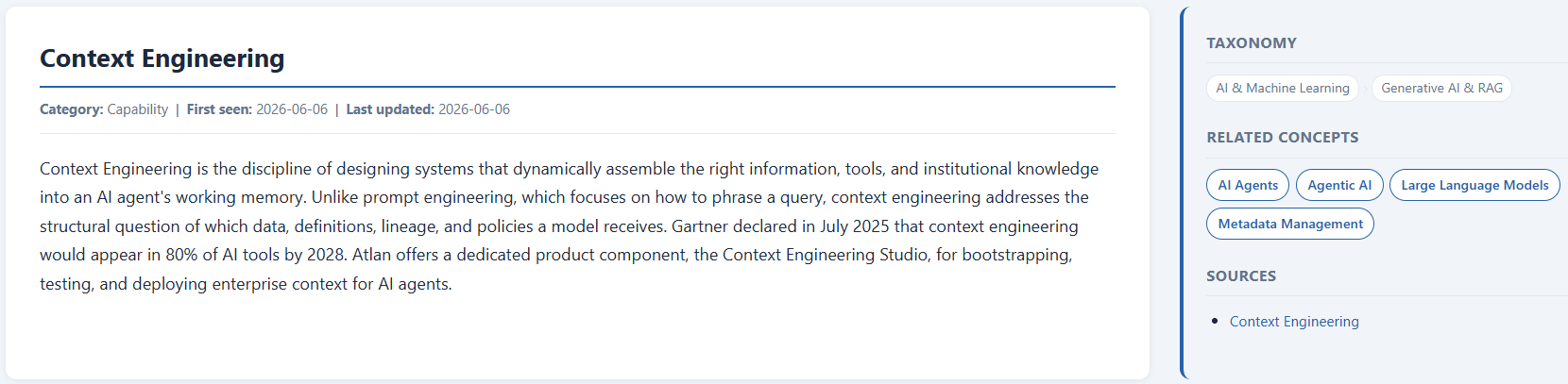
The discipline of designing and managing that assembly. Context engineering is the practice of ensuring that AI models and agents receive precisely the right information - accurate, current, permissible, and appropriately scoped - to complete a task reliably. It is distinct from prompt engineering, which focuses on how instructions are phrased; context engineering focuses on what information is made available to the model at all.
Context & Knowledge Engineering is one of the five capability dimensions that separate Market Leaders from Challengers and Specialists. It is a competency that spans technical platform capabilities (what the platform can assemble) and organizational practice (how teams design and govern that assembly).
What Context Engineering Covers
Context engineering operates across five domains:
Retrieval strategy - deciding which sources to query and how. A flat keyword search over catalog entries is not the same as a graph traversal that follows business entity relationships across three hops to surface a relevant policy. The quality of context depends critically on how retrieval is structured. Platforms with knowledge graph architectures (Actian, DataHub, Collibra) enable retrieval that respects semantic relationships, not just lexical similarity.
Context selection and ranking - filtering the retrieved results to what is actually relevant for the specific task. A data quality issue in a source table upstream of a report is relevant context when an agent is generating that report. The same issue in a different domain is noise. Context engineering requires building this relevance logic explicitly - either via retrieval-augmented generation with embedding similarity, or via structured rules derived from lineage and business metadata.
Permissioning at assembly time - enforcing access controls before context reaches the model, not after. If a model sees sensitive data and then decides not to use it, the data has already been exposed. The correct architecture enforces permissions at the context layer boundary, filtering the assembly output to what the requesting agent identity is authorized to see. This is governance applied to the context layer, not just to the data sources it draws from.
State and memory management - allowing agents to accumulate context across a session without re-querying the catalog on every step. Multi-step workflows - an agent that identifies a data quality issue, traces its lineage, notifies a steward, and logs a remediation task - require a persistent context state. Platforms that support this distinguish themselves from those that treat every agent request as stateless.
Auditability and evaluation - knowing what context was provided to which agent, for which action, and whether it produced a correct result. This is the feedback loop that makes context engineering an iterative discipline rather than a one-time design task. Platforms that log context delivery - who asked for what, what was assembled, what was withheld - enable organizations to debug agent failures and improve retrieval quality over time.
What Vendors Are Building
Leading platforms are constructing context layers through several converging mechanisms.
MCP as the connective tissue. The Model Context Protocol has become a de facto interface standard between data intelligence platforms and AI agent frameworks. Alation, Atlan, Collibra, DataHub, Informatica, Ab Initio, Alex Solutions, Actian, and DataGalaxy have all deployed MCP servers that expose catalog metadata - assets, glossary terms, lineage, quality scores, policies - to agents via a standardized tool-calling interface. The platform stops being a UI for human users and becomes an API endpoint for autonomous processes.
Context graphs over flat catalogs. DataHub’s architecture explicitly models the context layer as a graph that blends structured metadata with unstructured business knowledge from Confluence, Notion, and Google Drive. The Agent Context Kit allows agents to both retrieve context from and write learned context back to the graph - creating a feedback loop between agent behavior and the knowledge base. DataHub as a platform is most explicitly designed as an enterprise context layer for agentic AI operations.
Active metadata as a control signal. Ab Initio uses metadata not only as documentation but as a runtime instruction set. Its execution model drives pipeline behavior, quality checks, policy enforcement, and access controls from metadata at runtime - the metadata layer is operationally live. For agentic workflows, this means agents inherit policy and lineage context automatically rather than having to query for it separately.
Semantic modeling for agent grounding. Atlan’s Context Studio, Collibra’s semantic knowledge graph (Neo4j-backed), and Informatica’s CLAIRE-powered semantic engine aim to give agents a structured ontology of the enterprise data estate - not just a list of tables, but a graph of relationships, ownership, quality, and meaning that agents can navigate and reason over. Actian’s federated knowledge graph architecture extends this to multi-domain organizations, maintaining domain-local metadata while exposing a unified graph surface for retrieval.
Governance at the context boundary. A context layer without access controls is a data leak in the making. The leading implementations enforce permissions at the point of context assembly: Alex Solutions’ MCP server operates as a read-write context engine that enforces the same policies at agent request time as at human query time. Collibra and Informatica push policy enforcement downstream into Snowflake, Databricks, and BigQuery, so the source system enforces what any consumer - human or agent - can see.
The Capability Gap
Only 37% of organizations report meaningful AI readiness improvements (BARC, 2026) from their current data management investments. The diagnosis is clear: most organizations have built the semantic layer - the catalog, the glossary, the lineage - but have not wired it into their AI systems at inference time. The catalog is a library. They need a librarian that responds to agent requests in milliseconds, with full awareness of what the requesting agent is allowed to see.
The gap between a data catalog and a functioning context layer encompasses several components that are still maturing across the vendor landscape:
Context retrieval and assembly - selecting the right subset of metadata for a given agent task, not just returning search results
State and memory management - allowing agents to accumulate context across a session
Agent identity and permissioning - enforcing access controls against an agent principal, not just a human user
Auditability - logging what context was provided to which agent for which action
Freshness guarantees - ensuring that context delivered at inference time reflects the current state of the data estate, not a stale cache
Top solutions for the Context Layer are currently Informatica, DataHub, Ab Initio - each address several of these dimensions. No single platform covers all of them at the same depth.
Building a Context Engineering Practice
Context engineering is not a feature organizations buy - it is a capability they build. The platform provides the infrastructure; the organization provides the design decisions that determine how well it works.
Define the agent contract first. Before designing a context layer, specify what each AI agent is expected to do, what data it needs, what it must never see, and what decisions it is authorized to make. This agent contract drives both the retrieval strategy and the permissioning model.
Treat context as a product. Just as data products have owners, SLAs, and quality metrics, context packages should have the same. Who is responsible for keeping the glossary terms that feed a retrieval pipeline current? What is the acceptable staleness for a quality score that informs an agent decision? These are operational questions that context engineering makes explicit.
Start with lineage-grounded retrieval. The most robust context for an agent reasoning about a business metric is not a free-text similarity search over catalog entries - it is a traversal of the lineage graph from that metric back to its source tables, combined with the business definitions and quality rules attached to each node. Lineage-grounded retrieval is more deterministic, more auditable, and more resistant to hallucination than embedding-only approaches.
Build the feedback loop. Context engineering improves when agents can write back what they learn. An agent that discovers a missing definition, identifies a lineage gap, or flags a quality anomaly should be able to update the catalog — pending human review if required — so that future retrievals benefit from that knowledge. DataHub’s Agent Context Kit and Ab Initio’s active metadata model both enable this pattern. It is one of the clearest differentiators between a context layer and a read-only metadata API.
What This Means for Platform Selection
For organizations evaluating data intelligence platforms in 2026, the context layer question is now a first-tier selection criterion - not a future roadmap item. The questions that differentiate vendors are:
Does the context layer enforce governance at assembly time, or does it expose raw metadata and trust downstream systems to enforce?
Can the agent write context back - updating documentation, signaling quality issues, contributing learned lineage - or is the flow read-only?
Is the semantic model rich enough to support multi-hop reasoning, or does it describe assets without capturing their relationships?
How does the platform handle agent identity - as a human user proxy, or as a distinct principal with its own permission scope?
Does the vendor provide tooling to audit what context was assembled and why?
The data catalog solution that answers these questions well becomes foundational infrastructure for every AI workload in the organization. The one that does not becomes a catalog that agents have to work around.